FOR PERSONAL TRAINERS, PILATES & YOGA TEACHERS, MOVEMENT COACHES AND PHYSIOS
WHO WORK WITH REAL BODIES, ONE AT A TIME.
Have A Foot & Ankle Physio On Your Team —
Without Hiring One
Thirty years of foot and ankle experience, yours to ask every single week.
Bring your hardest case, the collapsing arch, the bunion, the ankle that won't bend, the client whose knee or lower back keeps flaring, and get a specific, detailed answer you can use in the next session.
£29 a month · Pay nothing today to try it out · Cancel in two clicks
You can see it.
The arch that folds on every single rep. The big toe that barely moves. The heel that lifts before she's halfway into the squat. The one foot that turns out and the other that doesn't.
You know it matters. You've known for a while.
And then you get to the part where you'd have to actually do something about it — and there is nobody to ask.
So you work on the hip instead. And you tell yourself that's the responsible choice.
Why the foot keeps turning up
Twenty-six bones. Thirty-three joints. More than a hundred muscles, tendons and ligaments. The only part of the body that touches the ground, and the first thing to move in every step your client takes.
When it stops working properly, it doesn't stay a foot problem. Here's where it goes instead:
- The knee that keeps flaring and never quite settles, however much glute work you programme
- The squat that won't go deeper, because there's no ankle dorsiflexion to descend into
- Lower back pain that improves for a week and comes straight back
- Gait that looks wrong and you can't say precisely why
- Balance work that stalls at the same point every time
- Compensation patterns you keep chasing up the chain and never quite catch
- Left–right asymmetry that no amount of unilateral work seems to shift
- Posture that snaps back the moment your client stops thinking about it
- Plantar fasciitis, bunions, shin splints, Achilles pain — the ones that keep coming back
You already suspect most of this. That isn't the problem.
The problem is what happens next.
Without the correct tools, you have four options
Say you look at a client's foot on Tuesday and you're genuinely not sure what you're seeing. Here's the entire menu currently available to you.
01
Hire a specialist
A foot and ankle physiotherapist with real experience is a consultant, not a hire. If you could get one on retainer at all, you'd be looking at hundreds a month for a handful of hours. This isn't a realistic option and you know it.
02
Send the client for a private assessment
£60 to £120 of their own money, for something she didn't ask for and doesn't yet believe is the issue. Half the time she doesn't book it. When she does, you get a report you can't fully interpret and no line of communication with the person who wrote it. You still don't know what to do on Thursday.
03
Refer out and wait
Sometimes this is exactly right, and we'll come to how you tell. But when it's your default for anything foot-shaped, look at what it actually costs you. Four to six weeks with the client in someone else's care. Two sessions a week at £50 is £400 to £600 of revenue gone — from one client. Someone else gets the credit for the fix. And you learn nothing, so when an identical foot walks in next month you're in precisely the same position.
04
Do nothing (the one nearly everybody picks)
Keep working around the foot. Keep programming the hip. Keep hoping. Which feels careful. It isn't — because nothing has a cost too, and it's the biggest one on the list. Six more weeks of a plateau you can't explain. A client quietly deciding this is just how her body is now. The block that doesn't get renewed — not angrily, just permanently.
None of those four options is "get a specific answer from someone who actually knows, this week."
That option has never existed at a price a fitness professional could justify. That's the entire reason The Foot Room exists.
Why learning more hasn't fixed it
You might be thinking: fine, I'll just get better at feet. You've tried. Here's why it hasn't worked, and it isn't your fault.
Free content actively makes it worse
Go looking for answers about feet and you'll find four confident, contradictory ones inside ten minutes. A coach with 200,000 followers says arch support is the biggest scam in the industry. A podiatrist says that's negligent — orthotics are to feet what glasses are to eyes. A researcher says the whole conversation is overblown. A physio says transitioning an orthotic-wearer to barefoot is borderline malpractice.
They can't all be right. And none of them has met your client.
And courses stop one step short of where you actually need help
Let's be fair to courses. There are three good ones sitting inside this membership. A course transfers information well, and Jane's do. But look at what a course structurally cannot do, however good it is.
A course is a monologue. It answers the questions the person filming it thought to anticipate, in the order they chose, for a student who doesn't exist — the average one. Your client is sixty-eight. Or eleven weeks post-op. Or a marathon runner with a big toe that hasn't extended properly since 2019. The module was recorded for nobody in particular.
A course can tell you what to do. It can't tell you whether you did it right. There's no feedback loop anywhere in it. You can run the wrong progression on the wrong foot for four months and nothing will correct you.
A course ends precisely where the hard part begins.
And here's the one nobody mentions: the better you get, the better your questions get. Your questions in month six are sharper than your questions in week one. More specific. More clinical. More about this client, this foot, this history. A course can't answer a single one of them, because a course stopped talking a long time ago.
That's why you've got a folder of courses you three-quarters finished. It was never laziness. They ran out before your questions did.
| A standard course | The Foot Physio Training Room |
|---|---|
| ✕ Answers the questions the creator anticipated | ✓ Answers the question you actually have, about the client you actually have |
| ✕ Made for the average student | ✓ Applied to the sixty-eight-year-old with the fused big toe, because that's who's in front of you |
| ✕ Tells you what to do | ✓ Tells you whether you did it right |
| ✕ One-way. Nobody to ask. | ✓ You ask. Every week. |
| ✕ Ends at module eight, where the hard part starts | ✓ Doesn't end |
| ✕ Identical in month twelve to day one | ✓ Bigger every week, as the Case Library grows |
| ✕ You interpret it alone | ✓ A specialist interprets it with you |
| ✕ You'll get it broadly right and never learn which bits you got wrong | ✓ You find out in days, not years |
| ✕ Priced as though the content is the valuable part | ✓ Priced on the thing that's actually scarce — the expert's attention |
None of that is an argument against courses. You get three of them here, and they're good. It's an argument against buying a course on its own and expecting it to be enough. It never was.
Which, incidentally, is exactly why Jane stopped selling them separately. She could carry on taking £97 from people who'd watch six modules, hit their first confusing foot and stall. She'd rather put the courses somewhere she can answer the question that comes next.
So the real gap was never knowledge. It was judgement.
And judgement, in this field, means someone qualified looking at one specific foot and telling you what they'd do about it. You can't get that from content. You can only get it from a person.
Who you'd be asking
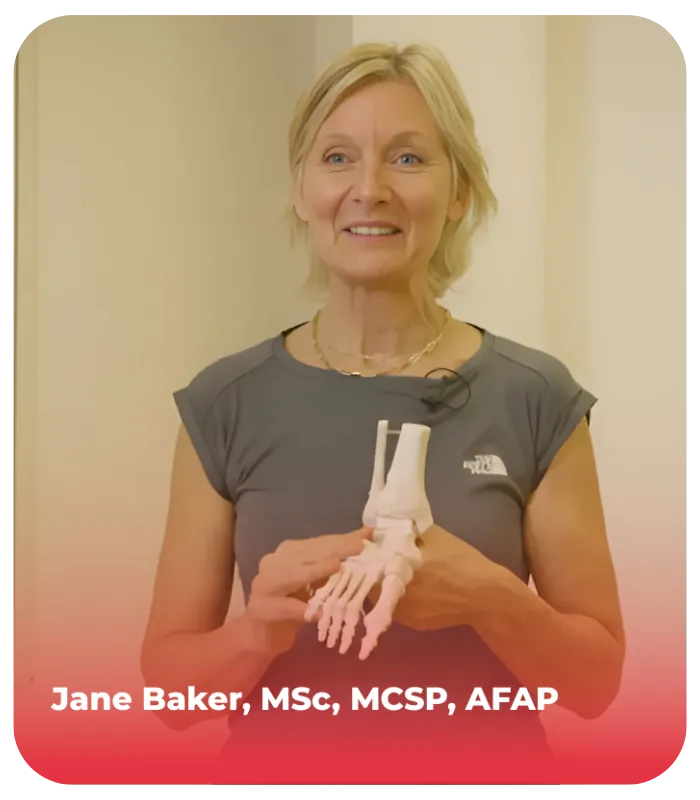
Jane Baker
Foot and ankle specialist physiotherapist. Thirty years in practice. Fifteen of them on feet and ankles specifically, working alongside leading foot and ankle surgeons in London.
- MCSP — Member of the Chartered Society of Physiotherapy
- HCPC registered
- MSc
- Member of the Association of Foot & Ankle Physiotherapists
- Post-graduate training in lower-limb biomechanics
- Foot mobilisation & functional movement assessment
- Running injuries specialist
But the credential that should matter most to you isn't on that list.
Jane works in the room where feet end up. Not the room where they get argued about online. The room at the end — where the joint gets fused, where the bunion is corrected surgically, where someone is learning to walk again at sixty-one.
And almost every one of those feet started, decades earlier, as something a competent fitness professional could have spotted and worked on.
That's a vantage point nobody else teaching this has. No content creator has watched a first MTP joint get fused. No surgeon is going to explain to you what a personal trainer is allowed to do about it. Jane stands in both rooms, which is precisely why her answers are usable by you.
The reframe first, because it changes what you're aiming at
You do not need to become a foot specialist. That takes fifteen years and it isn't your job.
Here's what actually separates a physio from you on this: it isn't that they know everything. It's that they know who to ask. Every good clinician has a network — the person they ring about the complicated foot, the shoulder, the one that doesn't add up.
You've never had that. Not because you're less capable, but because nobody ever offered it to you at a price that made sense.
That's the whole product. Not education. Access.
And it explains why the internet contradicts itself
All that conflicting advice is written for populations. You work with individuals. "Get out of your shoes" is right for some feet and reckless for others. "Support the arch" is right for some feet and a crutch for others. Both camps are correct — about roughly half the feet they're shouting at, with no way of knowing which half is listening.
So the skill isn't picking the winning side. It's being able to look at the foot in front of you and tell which one it is. That's learnable. Just not from content, because content doesn't know whose foot you're looking at.
Three parts, and they fit together
01
You learn to see — in your first week
An eight-point screen you can run on any client in ten minutes. Fully inside your scope, diagnosing nothing. Six dysfunction patterns to recognise on sight, and what each one does to the chain above it. Usable the same afternoon.
02
Every week, you bring a real client to The Case Clinic
This is the part that doesn't exist anywhere else, so let's be precise. Once a week, Jane runs a live clinic. Members submit an actual client — screen results, a video of them walking, a photo of the foot, the history, what you've already tried. Jane works through them live. Out loud. Including the reasoning, which is the part you can never get from a video.
Not tidy case studies chosen to illustrate a point. Your clients. The awkward ones. The ones that don't fit the module.
You get the specific answer: this is what I'm seeing, this is what I'd do first, this is what I'd expect in three weeks, this is what would make me change my mind, and this is the point at which I'd want to see her myself.
Can't attend live? Submit in writing beforehand and your answer is in the recording with your name on it. Most members never attend live. It works the same either way.
03
Every finding gets a lane — and this is where the fear goes
Everything your screen turns up sorts into one of three:
🟢 GREEN - this is yours. Train it. Here's the protocol, the progression, and how you'll know it's working.
🟡 AMBER - bring it to the Clinic. Not obviously yours, not obviously a referral. Don't guess and don't refer by default. Bring it this week and find out.
🔴 RED - refer out today. Here are the flags. Here's how to say it without frightening her. Here's how to build the relationship so she comes back to you.
Now look at what amber really is.
Amber is every foot you've quietly avoided across your whole career.
Every case where you weren't confident enough to act and not worried enough to refer — so you worked on the hip and hoped.
A course can only ever teach you green and red. Amber needs a specialist you can actually reach, which is exactly why this is a membership and not another product.
AND THIS IS WHY THE CHANGES LAST
One more thing worth saying plainly
Because it's the difference between managing a foot and changing one.
A brace accommodates. An insole accommodates. Both have their place, and Jane will tell you exactly when — she works with the surgeons who deal with what happens when they're used badly.
But a foot is twenty-six bones and a hundred-odd muscles. It's trainable tissue. Range of motion improves. Intrinsic strength improves. Balance improves. Sensory input improves. A big toe that hasn't extended properly in a decade can start extending again.
You can't change genetics, but you can change function.
Which is why the results here don't wash out the moment your client stops thinking about her posture. You're not cueing a compensation. You're rebuilding the base everything else stands on.
What you get
In your first week: the ability to see
Screen The Feet — the 8-Point Screening System
Sixty minutes, then it's yours. Standing, walking, squat, ankle dorsiflexion, calf raise, balance, hallux and foot observation screens. Plus the six patterns you'll meet most — overpronation, high arches, restricted dorsiflexion, poor balance, limited big toe range, forefoot dysfunction — and exactly what each does to the knee, hip and back above it.
Sold on its own for £29 until now. You get it before you pay anything.
The Red Flag & Referral Protocol
What to refer, when, to whom, and the words to use. Written for a fitness professional's scope by the person who receives the referrals.
Every week, for as long as you're a member
The Case Clinic
Live with Jane. Bring your client, get a specific answer. Submit in advance if you can't make it.
The Case Library
Every case ever solved in the Clinic — written up, filed by condition, searchable. This is the part that gets more valuable every week you stay, and the reason the price will rise: a specialist's actual reasoning on real clients, which has never existed in this field in any form.
The Traffic Light System
Green, amber, red, applied to everything you find.
The Training Room
Trainers, Pilates and yoga teachers, movement coaches and physios, all working the same problem. Not a Facebook group full of arguments — a working room.
From day fifteen: the full library
Meet The Feet — 8 modules, 40+ lessons
Previously £97
Practical Foot Anatomy & Physiology
Range of motion — measuring it properly, and what the number actually means
Intrinsic foot strength — the Michaud Card Test, Toe Yoga, Short Foot progressions
Extrinsic strength — isometrics, band progressions, calf protocols
Balance — the single-leg progression system and the Clock Drill
The sensory foot — self-massage, soft tissue work, gait assessment
Increasing range of motion — dorsiflexion and big toe mobility protocols
Toe separators, alignment and footwear: what helps, what's theatre
Meet The Bunions — 5 modules
Previously £47
- Why nobody is born with a bunion, and what that means for your client
- The instability at the tarsometatarsal joint that's actually driving it
- The kinetic chain — hip position, and re-establishing the neural pathway
- The toolkit: release work, the foot screw correction, big toe abduction, band work
- The little toe nobody mentions: Tailor's bunions
- Footwear, spacers, and transitioning someone without hurting them
Plus everything Jane adds from here. New material lands inside the membership. Nobody buys it twice.
What you'll be able to do
Run a ten-minute foot screen on any client, inside your scope, diagnosing nothing
Tell in about ninety seconds whether a stubborn knee, hip or lower-back problem is coming from the ground up - or isn't, which saves you just as much time
Know which clients should come out of supportive shoes and which absolutely shouldn't - the question the entire internet is shouting about and nobody can answer for an individual foot
Find the missing ankle dorsiflexion that's been capping your client's squat depth for two years
Explain to a client why her bunion happened without using the word "genetic" - and what can still be changed
Rebuild intrinsic foot strength properly, in the right order, so it holds
Spot the red flags that turn today's session into a phone call
Refer out in a way that makes a physio or podiatrist want to send someone back to you
Stop referring the cases that never needed referring - and keep the revenue that went with them
Prescribe the right drill on the right rung, because Short Foot on an ankle with no dorsiflexion is why the last three attempts failed
Show a specialist your hardest client, every week, and know exactly what she'd do
What members say
Over 700 fitness professionals have already joined The Foot Physio Training Room. Here's what some of them say.
The weekly live Q&A sessions have been incredibly valuable because they explore real, everyday issues shared by members, with Jane bringing an impressive depth of knowledge to every discussion. One of the most important things I’ve learned is the value of keeping our feet strong and recognising that an issue in the feet may be connected to something happening further up the body, or vice versa. I would absolutely recommend the live Q&As. Jane’s ability to clearly explain and demonstrate complex issues involving the feet has helped me greatly in my work as a Pilates instructor.
Firstly having a very educated and experienced foot physio spend time to listen to our questions whether personal or about a friend and giving such precise answers using visual as well as spoken answers. So many questions already been answered but my questions on footwear and stiff big toe, such a lot of information directing me to how i can rectify. Eventhough i have done all courses so far, to have you answer me verbally and show me why…. So fantastic. I practice all moves everyday and share with my exercise and clinic participants which enable to keep my clients ‘MOVING’ Honestly please join us in these weekly sessions, everyone has the chance to answer questions and for some, just listening seems to be as helpful. Why would you not, so amazing to have this free session and it just cements that knowledge learnt on all courses. the courses are all so easy to understand and always if you have a question Jane answers in the community group or personally Thank you Jane, i so enjoy the courses and the weekly sessions.
I think it is great to have your own questions on issues being professionally answered and elaborated on. But to also listen to other participants questions is very valuable. These webinars are really widening my knowledge. I would say that this is a great opportunity to discuss feet issues with an expert but also having the chance to get input from other people who work with feet.
The Q&A sessions are incredibly valuable. Being able to ask any question related to the feet and legs and receive clear, practical answers has helped deepen my understanding of foot anatomy, biomechanics, and how the whole body works together. What stands out most is the depth of knowledge and experience behind the teaching, along with the ability to explain complex topics in a simple, easy-to-understand way. Whether I need a practical solution to a specific issue or clarification on a broader concept, I always come away with useful insights. I would absolutely recommend both the Q&A sessions and the course to bodywork professionals who want to improve their knowledge and skills. Anyone not taking part is truly missing out.
The breadth and depth of your knowledge is really evident, but what I find particularly valuable is the way you explain things so clearly and make quite complex information about the foot accessible and relevant. I also really appreciate how generous you are with your time and with sharing your understanding - including taking the time to respond to my specific questions and individual situations. I came away from the Q&A with a better understanding of what is going on for my client, and that has influenced the way I think about and teach movement. I've really valued the opportunity to ask questions about issues I've observed personally and with my yoga and movement clients.
The most valuable part has been having direct access to someone so professional and knowledgeable, who can explain things clearly in real time and respond to specific questions. I can bring questions relating either to myself or to people I teach and receive clarity from a highly experienced physiotherapist. Unless I happened to know someone personally, I would never normally have this kind of opportunity, so it is an amazing and extremely valuable resource.
Elizabeth Banks
Personal Trainer & Movement Therapist
Louise Alwyn
Physiotherapist
Nina Robinson
Physiotherapist
Julie Driver
Pilates Instructor
Who this is for
- Personal trainers whose clients keep stalling on the same thing
- Pilates and yoga teachers who look at bare feet all day and were never taught what they're seeing
- Strength and movement coaches tired of cueing knees out and hoping
- Running coaches whose athletes keep returning with the same injury in a different place
- Early-career physios and sports therapists who got roughly ninety minutes on the foot in their entire training
- Anyone who has ever thought "I think it's the foot" and then done nothing about it
Who this isn't for
- Anyone who wants a certificate for the wall. There isn't one yet. You'll get skills you can use on Thursday, not a qualification.
- Anyone who wants to be told which camp is right. Jane won't do it. The answer depends on the foot, and if you want a slogan you'll be disappointed.
- Anyone hoping this makes them a physio. It won't and it isn't trying to. It makes you excellent inside your scope and completely clear about where the edge is.
- Anyone who won't bring a case. You can just watch the videos. You'll get a fifth of what's here, you'll cancel in month three, and you'll be right to.
Join Today and Get Instant Access
What's included
Value
The Case Clinic — weekly live access to a foot & ankle specialist
£600/month at consulting rates
The Case Library — every case solved, searchable by condition
Grows every week
Screen The Feet — the 8-Point Screening System
£29
Meet The Feet — 8 modules, 40+ lessons
£97
Meet The Bunions — 5 modules
£27
The Traffic Light Scope System
—
The Red Flag & Referral Protocol
—
The room
—
Everything Jane adds from here
—
The three courses sold individually for £153 right up until recently. They aren't sold separately any more. This is the only way to get them now.
£29 a month
Free for the first fourteen days.
Why it's this price — and why it won't stay here
Put £29 next to the four options you had before.
Employing a foot & ankle specialist
Not available to you at any sensible price
One private foot assessment for one client
£60–£120 of her money, once
An hour of specialist time, one to one
Around £150
Referring one client out for five weeks
£400–£600 of your revenue, gone
The Foot Physio Training Room
£29/month
Roughly four hours of specialist access
That works out at about £7.25 per hour of expert time. The nearest comparable membership is around £39 a month with a three-month minimum, no free trial, and one call a month where the hosts choose the cases rather than the members.
And set it against the other thing you'd otherwise do with the money: a single one-off course, at £97, that stops answering the moment you close it. Month one here costs £29 and includes three of them — plus the person who made them.
And here's the arithmetic that should actually decide it.
Keep one client this year who'd otherwise have been referred out — one — and the membership has paid for itself several times over.
To be completely clear: red still goes out, today, every time. That never changes. The saving is on amber — the cases that never needed referring at all, where you referred because you couldn't tell the difference. That's most of them.
So no, £29 doesn't reflect what's in here, and we won't pretend it does. It's a founding rate, it's deliberate, and it's temporary.
Join now and £29 is your price for as long as you stay a member. When it moves to £39 and beyond, it doesn't move for you.
Every week that passes, the Case Library gets bigger — so everyone joining after you gets more than you did and pays more for it. That's the only urgency on this page, and it's real.
Try it out for free
Fourteen days free. No charge, and you can walk at any point inside it.
- In those fourteen days you get Screen The Feet — the £29 mini-course — and a live Case Clinic. Real access, before any money moves.
- Your one job in the trial: screen ten pairs of feet, and bring one of them to the Clinic. Do that and you'll know inside a fortnight whether this is worth £29 a month.
- No minimum term. Cancel in two clicks whenever you like. We'll email you before we bill you, every time. No three-month lock-in, no phone call, no hunting for the button.
No charge today. Screen The Feet unlocks immediately. Cancel in two clicks, any time.
Frequently asked questions
How is this different from just doing another foot course?
Answer coming soon.
I've bought courses before and not finished them.
Answer coming soon.
I can't commit to a live call every week.
Answer coming soon.
Is this actually inside my scope?
Answer coming soon.
Won't this make me stop referring people who need it?
Answer coming soon.
I could learn this free on YouTube.
Answer coming soon.
Why a subscription rather than just buying the course?
Answer coming soon.
What if I cancel — do I lose everything?
Answer coming soon.
Does it count towards CPD or CEUs?
Answer coming soon.
I'm a Pilates teacher, not a personal trainer. Is this for me?
Answer coming soon.
Will there be new material?
Answer coming soon.
You've got feet in front of you this week. Bring one to the Clinic.
You already suspect it's the foot. You've suspected it for a while. Fourteen days from now you're either still working around it — or you've screened her, brought her to the Clinic, and heard thirty years of foot and ankle experience tell you exactly what to do next.
No charge today. Screen The Feet unlocks immediately. Cancel in two clicks, any time.